INTRODUCTION
Microorganisms make up a vast portion of organic life on the planet. The biological and ecological importance of microbes, bacteria, fungi, and archaea for the species known as Homo sapiens cannot be overstated. It’s widely understood that 90 percent of the cells in the human body are microbial. While the exact percentage may shift as more research is undertaken, scientists tend to agree that the balance is heavily favored toward bacterial cells in the makeup of the human body and genome.
As a collection of millions of cells, bacteria, microbes, and nanoparticles encased in bodies, endowed with awareness, dreams, mentality, cognition, and interiority, humans defy categorical reductions. Our microbial origins demonstrate this. Symbiogenesis—becoming by living together—refers to the theory, elaborated by evolutionary biologist Lynn Margulis in the 20th century, that once-independent, free-living bacteria performed lateral gene transfers and fused into the cellular structures of what become animal and plant life. This established the importance of symbiosis in the evolution of all organisms.
We are not simply human, nor individual. This is the central conceptual ground from which the rest of this project follows. Our skin, our gut, our brains, our bloodstreams are all populated with their own diverse communities of microflora, some activating only when certain events take place, from the microbiome’s digestion of the food we eat to the necrobiome’s burst of activity when we die, decaying our corpses. In one sense, we know ourselves to be specialized matrices of biological and evolutionary processes, as complex beings, as networks or chains of systematic growth and decay programs that perform the limits of our hardware and software. In another, we think of ourselves as somehow separate from nature, from one another, from other species—masters of our world, resembling none. Interrogating these separations or divides is another key goal of this project, for which I apply a mix of technological and sensory approaches.
I became motivated to explore these contradictions through the lens of microbes, considering and contending with the vastness, complexity, and confounding nature of their reality as it relates to ours. In the process, I come across other organisms that also resist easy definition, such as fungi (some of which are considered microbes) and lichen (a symbiotic partnership between cyanobacteria, which belong to the category of microbes, and fungi). In an effort to understand them and the realities they create better, I embark on encounters in the natural world with an attention to the overlooked or unseen features of complex urban ecologies. The approach I’ve taken is a hybrid and chimeric one, combining research on science and technology with a field- and sound-based creative practice.
With an experimental methodology, I strive to integrate theory from the environmental humanities, natural science, science and technology studies, and deep/quantum listening to explore strands of thought surrounding human-environment relations and to open a critical discussion around the organization of categories that shape human and more-than-human lifeways. Key to this is a methodology that emphasizes the arts of noticing and attentiveness through passionate immersion in animal, microbial, and fungal worlds as they emerge in urban ecosystems, challenging human-centered models for understanding species. The arts of noticing refers to a conceptual and practical framework developed by anthropologist Anna Tsing, who employs the approach to attend to “the interplay of temporal rhythms and scales in the divergent lifeways that gather” in a range of environments.
I chose sound as the primary sensory mode to engage in an exploration of microbial ecologies. The microscopic size of bacteria makes them impossible to detect by sight. But rather than use a magnifying instrument to enhance my ocular senses, I felt this kind of activity was better suited to a controlled laboratory setting, and I wanted to get outside, into the elements. The living worlds of soil and the underground enticed me as a site for microbial engagement, with the knowledge that “soils host a diversity of microbial communities that provide key functions for environmental resilience,” as the editors of Thinking with Soils note, adding that “a dynamic belowground ecosystem [is] crucial for plant, animal, and human wellbeing.” Not only do microbial ecologies shape a fundamental aspect of what it means to be human on a biological level, but they are also key to ongoing survival in and of the environment as a whole.
In embracing soil as a site for field exploration and sonic experiments, I wanted to work toward a relational materiality of soils, as proposed by scholars Anna Krzywoszynska and Greta Marchesi. I would endeavor to absorb and confront their urgent assertion that “in a time of anthropogenic ecological destruction and linked societal crises, we urgently need greater attention to soil and land from all quarters.” Soil relationality and the diversity of underground ecosystems will be explored further in Part 2 (“Subterranea”).
Using sound recording technology—both physical instruments and digital tools—was a way for me to explore the embeddedness of humans in multispecies environments. What this means is that there is no way of thinking of the human without the involvement of other species in our infrastructures and models of knowledge production. Humans build an understanding of what it means to exist in confrontation and collaboration with other life forms, from the ‘big like us’ to the smallest units of life. Simply put: “All living beings emerge from and make their lives within multispecies communities.” The basis of multispecies studies is an acknowledgment that “life cannot arise and be sustained in isolation,” and all organisms, including humans, are “situated within deep, entangled histories” that support a recognition of species as an emergent, flexible, and heterogeneous concept of being and becoming.
This mode of inquiry takes up a different approach from taxonomy, the branch of science devoted to classifying organic life forms according to physical characteristics and genetic composition, creating an organizational system for sorting organisms into overarching categories that differentiate types with increasing specificity. Plants, animals, fungi, protists, bacteria, and archaea are the primary kingdoms of Linnaean taxonomy, referring to the 18th century Swedish biologist who pioneered this ordering system. While a multispecies framework for understanding species does not wholly divert from taxonomy, it pays attention not only to distinguishing characteristics but to patterns and processes as they are bound up in the behavior of organisms, centering passionate immersion as a mode of inquiry into multispecies worlds. In the words of scholars Thom van Dooren, Eben Kirksey, and Ursula Münster in an article on this approach:
Passionate immersion can take many forms. At its core it involves attentive interactions with diverse lifeways. Beyond viewing other creatures as mere symbols, resources, or background for the lives of humans, scholars in multispecies studies have aimed to provide “thick” accounts of the distinctive experiential worlds, modes of being, and biocultural attachments of other species. Immersive ways of knowing and being with others involve careful attention to what matters to them—attention to how they craft shared lives and worlds. Passion does not here mean to practice an unqualified enthusiasm or support for another’s flourishing. Immersion in the lives of the awkward, the unloved, or even the loathed is very possible. As such, some of this scholarship runs against the grain of dominant norms and sentiments, cultivating attentiveness to such creatures as ticks, pathogenic viruses, and vultures.
Taxonomy is a system for understanding evolutionary lineages by means of morphology, or the visual qualities of an organism’s form and behavior, which become the basis of description and comparison by which those organisms are assigned to categories and groups. In the 21st century, new technologies and techniques for genetic sequencing gave the field of taxonomy a renewed primacy in the biological sciences for fleshing out the tree of life with newfound levels of detail toward species classification.
I recognize the importance of taxonomy in establishing our breadth of knowledge of the natural world and its creatures—indeed, I am fascinated by the descriptive ability of taxonomists and the ways in which this work involves hyper-awareness of the smallest differences between organisms. At the same time, I question how taxonomy as a scientific discipline has established the parameters by which humans interact with the rest of the world by way of degrees of difference and individuality, creating hierarchies of being and relating by systematically organizing certain kinds of organisms over others, however unintentionally this schema may have developed from the original principles of the field. By visualizing taxonomic lineages as a tree of life, humans create a position for themselves at the top and shape a sense of kinship between species via measurable amounts of distance between branches, which comes to stand for a lack of connection or commonality compared to other types. I argue that taxonomy positions humans in an (inaccurate) all-knowing capacity over the natural world, which feeds into the notion of human dominion over the earth as an inevitable outcome. I also want to think through relationality, rather than individuality, toward a more collective ecology and ethics for urban ecosystems.
Instead of thinking along taxonomic lines as I engage with microbial ecologies and other shapeshifting forms of life, I consider the basis of species as an unfolding process resulting from emergent and indeterminate encounters or unpredictable collisions in the environment that bring species into being. In my complication of species, I echo multispecies scholars who are examining the ways in which this is a human construct, such as Timothy Ingold, who argues that “the notion of species is an anthropocentric imposition,” and Eben Kirksey, whose work examines “how species are enacted, how they are performed in specific ways” to reveal the limits of human knowledge systems such as taxonomy.
Moving away from taxonomy as a mode of understanding life follows other contemporary trends in philosophical thought such as posthumanism, which “calls into question the givenness of the differential categories of “human” and “nonhuman,” examining the practices through which these differential boundaries are stabilized and destabilized,” in the words of physicist and feminist Karen Barad, whose work is the focus of Part 4 (“One moment”). This represents a fundamental challenge to traditions of modern thought originating from figures such as René Descartes, whose influence in establishing the field of modern philosophy posits an “inherent distinction between subject and object, and knower and known,” and between the mind and body, a worldview that shaped all manner of achievements in science from the 17th century on. In the analysis that follows, I embark on a concerted effort to deconstruct the ‘Cartesian’ tendencies that mark species and their assumed boundaries to champion a sensory approach which vividly illustrates the categorical confrontations provoked by microorganisms. By way of a mediated relation to microbial ecologies via recording instruments, I aim to explore how the use of such materials brings species into being.
In my approach I take inspiration from Anna Tsing, who writes in The Mushroom at the End of the World (2015) of the transformative and life-making potential of the unpredictable and precarious, given its primacy in the order of our political, economic, and ecological time. Tsing builds the foundation of her investigation on matsutake assemblages by deconstructing the myth of linear time, progress, and growth of the 20th century, which has given way to structural conditions entirely governed by precarity in the 21st. For Tsing, the collapsing power of progress as a tale for earthly existence forces a reckoning with what ways of life have been unexamined or overlooked, and the terms by which we understand how organisms meet one another and how they change in those meetings.
Key to Tsing and other scholars, like philosopher and originator of the concept of vital materialism Jane Bennett, use the term assemblage to denote heterogeneous formations of human and more-than-human elements with indeterminate yet forceful potential. Bennett borrows this term from Deleuze and Guattari to describe “ad hoc groupings of diverse elements, of vibrant materials of all sorts… living, throbbing confederations that are able to function despite the persistent presence of energies that confound them from within.” Tsing interprets assemblages as “open-ended gatherings” that can achieve something more attuned to the complexity of ecological formations and work at undoing hegemonic narratives of progress and modernity that increasingly do not hold up against the precarity of the contemporary world. Tsing argues that precarity, rather than an anomaly or feared reality-in-the-making, in fact “is the condition of our time,” and that “thinking through precarity makes it evident that indeterminacy also makes life possible.”
I have termed this project a work of polyphony, which operates on multiple registers. In my methodology, polyphony has implications on the level of species conception, as an embodied tool for sonic attunement to the environment, and as a compositional framework for arranging or bringing together the varied elements of multiple recording instruments I use in the field. Tsing makes use of polyphony as a qualifier to the assemblage, aimed at capturing the rhythms of overlapping lifeways and as a way to make sense of how those ways of being shift in response to changing environmental conditions. Merlin Sheldrake, author of Entangled Life: How Fungi Make Our Worlds, Change Our Minds and Shape Our Futures (2020), also describes mycelium—that “most common of fungal habits, better thought of not as a thing but as a process: an exploratory, irregular tendency,” whose networks support the flow of water and nutrients in soil ecosystems—as “polyphony in bodily form.”
I identify a fertile connection between this theory of the soil assemblage—which includes microorganisms and mycelium—and the artistic and philosophical tenets of deep listening, pioneered by composer Pauline Oliveros in the 1980s. Deep listening is a theory and practice that stresses conscious and embodied attunement to all forms of sound in contrast to the automatic nature of most auditory perception. Listening deeply creates opportunities for the arts of noticing and for passionate immersion in microbial and mycelial realms. Part 3 (“In concert”) will further explore polyphonic composition and species as process-oriented practices that I aim to demonstrate via technical experimentation.
The notion of polyphonic assemblages also points me toward the time and reality-bending properties of microbial and mycelial ecologies, in all their fluidity, heterogeneity, and indeterminacy, which occupies the core themes of Part 4: quantum entanglements. Oliveros penned an essay in 1999 on quantum listening that described it as tuning into more than one reality at once. I seek to thread this positionality as the basis of artistic experimentation with the quantum theory of feminist physicist Karen Barad, whose onto-epistemological framework bridges “the entangled practices of knowing and being.” I argue that these concepts have implications for the microbial ecologies that are inextricably bound up with human nature-cultures and explore how representational understandings of the environment can be deepened by quantum listening.
METHODS
To record sounds from below-ground environments, I made use of equipment that invites reflection on how technology is used to capture and render fluid, multifaceted, heterogeneous natural-cultural environments. This equipment includes a hydrophone, a waterproof microphone that detects low-frequency sounds from soil, rock, and sand (adapted from a geophone element which can record vibrations and seismic activity). When I use the hydrophone, I plant or bury it in the ground or in sand at recording locations, where it is plugged in via cable to a Zoom recorder with an SD chip that I can later connect to a device to download the recording as a high-quality audio file. At the time of recording, I can also connect a pair of headphones to sample the output and adjust the hydrophone’s position if necessary, depending on the sensitivity of the recording.
I am also using a bio-feedback or biosonification instrument called the Pocket Scion, which converts electrical signals from plants, fungi, and other lifeforms into musical notes. This device was developed as a collaboration between music technology company Instruō and Tarun Nayar, who is also known as a musician under the name Modern Biology. The Pocket Scion is a compact, portable synthesizer that maps biometric data into musical expression via circuitry. Describing what happens when the instrument’s electrodes are connected to biological input, Nayar explains: “When both electrodes are plugged into a given organism, the circuit is completed and the plant or mushroom (or [human]) becomes a variable resistor in a circuit. As current flows through the 555 chip, the capacitors at two of the pins discharge successive loads of current, creating a pulse wave whose frequency depends on the RC time constant – in this case, the resistance of the organism,” with the resulting notes indicating “a change in electrical activity.” The Pocket Scion has four built-in instruments that users can switch between: Secret Garden, Fungal Waves, Treebeard’s Koto, and Soil Circuits. These recordings can also be downloaded as .wav files or as separate MIDI (Musical Instrument Digital Interface) tracks.
After recordings are made in the field, I use a variety of digital tools and programs to interpret, compose, and arrange the collected data into immersive audiovisual works. The mix of methods provokes a number of questions and reflections on how these artistic and technological tools bring the core concepts of my investigation into being: symbiosis, relation, multispecies, more-than-human, and encounter are among the key words being explored here.
When I’ve downloaded and organized the hydrophone and Pocket Scion files on my computer, I open them in a DAW, or digital audio workstation, called Ableton Live. Ableton Live is used by musicians and audio engineers for sound design, audio editing, musical arrangement, and live performance. The program allows me to create individual channels for the recordings I’ve collected as well as manipulations and interpretations of this material. One of those channels is for the original recording, while I can create additional channels for further instrumentation and audio effects and convert segments of the original recording into notes using MIDI.
With Ableton Live, I can adjust parameters such as gain, which controls and modifies the overall volume of a track, to pitch up or down certain elements captured by the hydrophone. This is especially useful for the hydrophone since it is capturing very low-frequency sound. Within Ableton I can also create MIDI channels to interpret the information from the original recording, converting it to notes or musical expressions. MIDI is a universal digital standard for creating audio and interacting with audio elements. It is a fundamental interface for audio composition, essentially a platform for working with digitally created audio.
The Pocket Scion, in addition to recording changes in electrical activity in whatever lifeform it is attached to, has a small CPU that processes signal changes into MIDI notes. The MIDI capability in the Pocket Scion is essentially an interpretative layer designed specifically for the instrument. Through that layer it outputs MIDI signals alongside the instrument’s biological feedback mechanism. Those MIDI channels can then be understood by digital instruments when they are imported into Ableton Live.
I’m interested in playing with the raw recording, MIDI instrumentation, and audio effects to produce an immersive polyphonic experience when interacting with the material. The source of all interpretations is the original recordings from the field, from which all subsequent compositions unfold. This approach allows for a greater range of available sounds and instruments: a wider toolbox for compositional purposes, producing a hybrid organic-technological chimera of its own. In the use of new technologies for experimental purposes, I am also brought into conversation with myself, or with the version of myself that started this project, yearning to break out of the digital in its totalizing influence as a language and mode of contemporary existence, and learning to make a new relationship with the tools of technoscience.
I have also experimented with TouchDesigner, a visual processing workstation that works in a similar way on a design level to a DAW like Ableton Live in that it allows the user to chain and process effects together. Its features and tools allow for a very basic, building-block foundation of visual algorithm design. In TouchDesigner I can create a chain using audio and/or visual input and attached effects that activate signal generators for a desired output via the program’s generative algorithm.
For the material I’m working with, I’ve created a visual effects chain that pairs sonic input—hydrophone, Pocket Scion, MIDI instrumentation, and combinations of all three—with videos I captured at field sites, setting up the chain to make the videos react to the sonic input. The basic structural components of TouchDesigner are described by operator families, which work with different kinds of data: texture operators, channel operators, and surface operators, for instance, which have unique properties and implementations for visual effects. The TouchDesigner additions provide another layer of polyphonic composition and contribute to the immersive experience of recording encounters within multispecies environments. The resulting audiovisual works also lend to a deep/quantum listening approach by engaging experimentally with multiple layers of lively matter underground, including microbial realms that elude standard observation, via hybrid organic and technological sources.
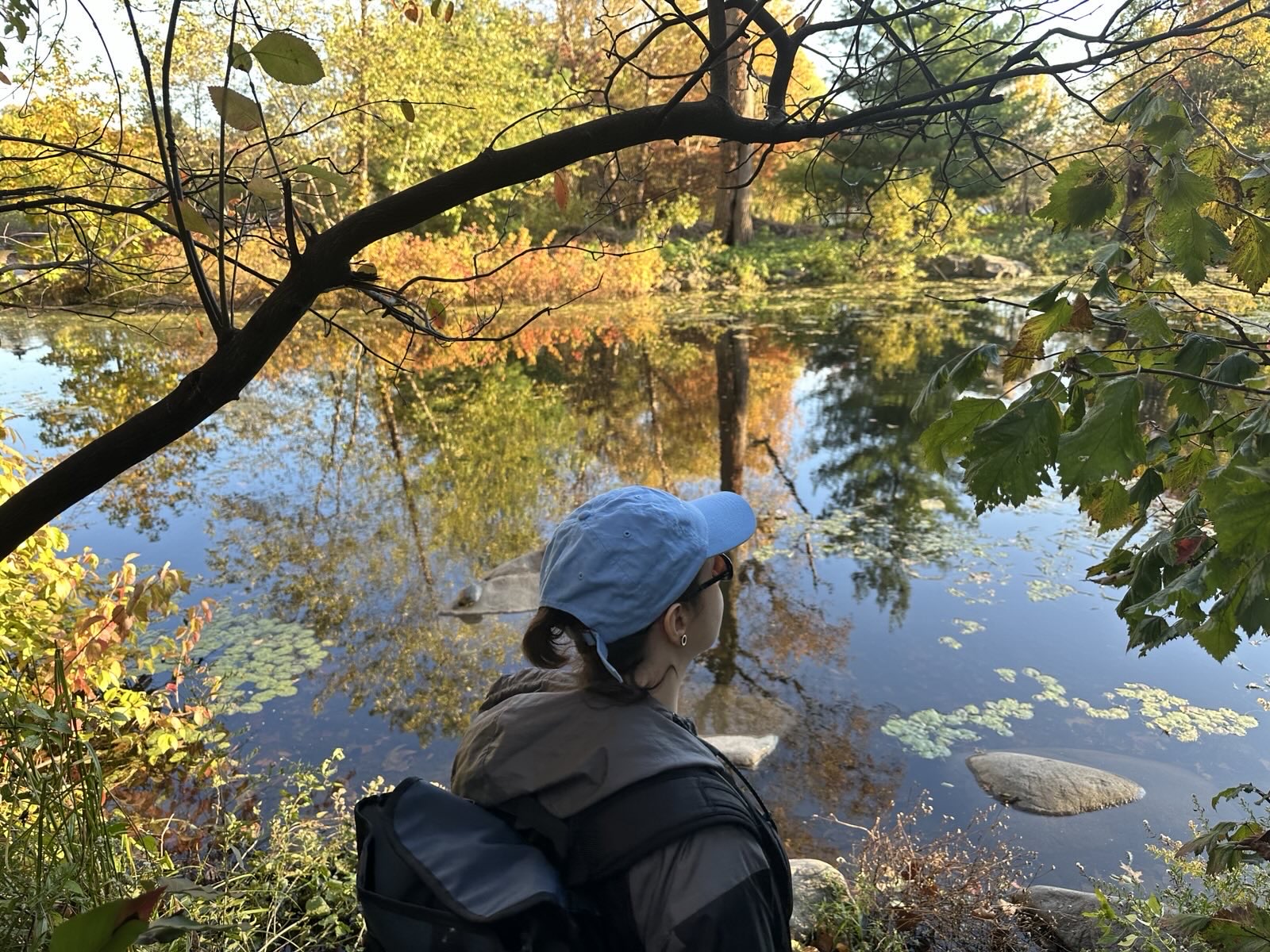
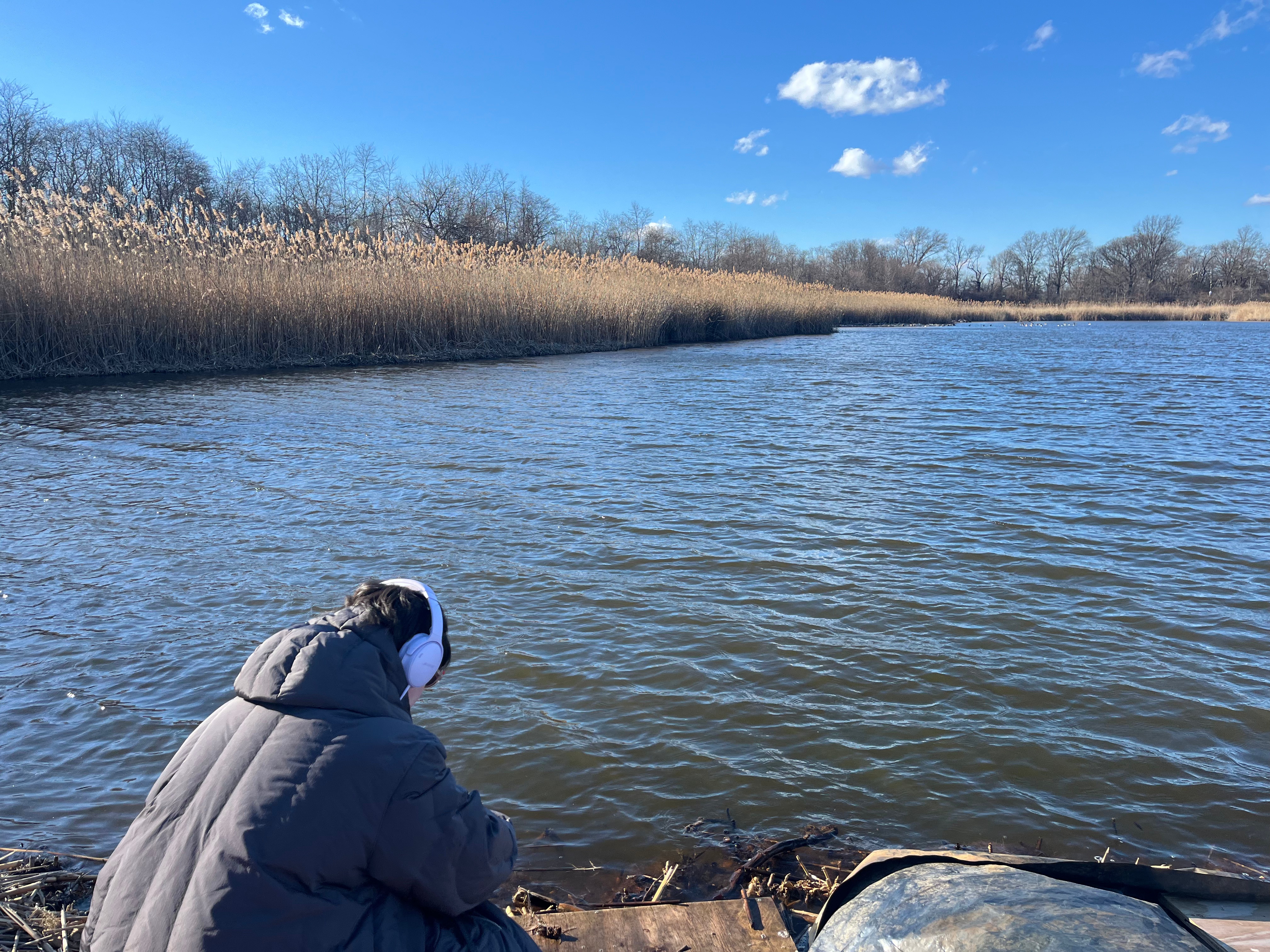
The works that follow are arranged and layered in a manner that strives to honor the diversity of the environments from which they were captured: a solitary forest in the heart of Brooklyn; the waterways of a forbidden pier off the coast of the East River; the inside of a forest lining the edge of a city reservoir. All works are presented, along with writing, at drinkthesound.com. The process of creating these hybrid audiovisual experiments presents opportunities to consider how interpretive acts of translation and inference create flexible categories of discrete organisms and ecologies—in other words, how the use of recording technologies bring species into being. In the writing that follows, I will explore the effects of these encounters and other themes introduced above: the diversity and mystery of underground, microscopic worlds in the soil and sand as a key to multispecies relationality; polyphony and deep listening as a guiding principle for attending and attuning to the co-constitutive nature of multispecies entanglements; the quantum potential of sound and listening to expand temporal registers in the interest of multispecies harmony; and opportunities for further sensory approaches in the natural sciences and more-than-human studies.

 One Moment Just to Drink the Sound