The underground or subterranean, the living world of soil, is a broad frame of reference to imagine. Soil stretches across the earth, covering 25% of the planet’s surface. Soil ecosystems are the foundation of the world’s agricultural system and integral to all efforts at survival and sustainability for the future. Yet in urban or peri-urban environments—zones at the border between urban and rural—soil is not necessarily at the forefront of our activities and engagements with the environment. Amid the concrete and metal of the city, soil is a disregarded living infrastructure. It is also the site of a huge volume of microbial life: a single teaspoon of soil, for instance, contains “more bacteria, protists, insects, and arthropods than the number of humans who have ever lived on Earth,” as well as “hundreds or thousands of meters of fungal mycelium.”
The term ‘infrastructure’ is my way of getting into the global presence of soil and, as an idea and practice, points to the ways in which I seek to position soil ecologies as an urban phenomenon. Living in the city, I am continually navigating transit, grids, and traffic—patterns of movement, unpredictable as they may be, that follow an operating system governed by principles of order. Order and control are central to city planning. But none of this can be built without the essential structure of soil, a living world whose categorical makeup defies easy definition and methods of control.
As the result of geological and biological processes over long periods of time exceeding human schedules of development, soil is marked by a kind of diversity and unevenness that makes it difficult to pin down as one thing or another. As Krzywoszynska and Marchesi write: “The materials and organisms in soil are so tightly coconstituted that there are no obvious ways of distinguishing where one entity ends and another begins. Bring to mind the tip of a tree root, with its complex associations of fungal hyphae, bacterial colonies, roots of other plants, with its immersion and participation in hydrological, atmospheric, and mineral media. Where does a tree root end and a soil begin?” This prevents soil from being grasped as a fully knowable entity; instead it materializes as an emergent set of relations, with an indeterminate beginning and/or end. This challenges human systems of order that seek precise definitions, assume clear borders between objects, and conceive of soil as a means toward an end within the urban real estate economy.
In contending with the ontological multiplicity of soil, I am also confronted with the nature/culture divide and a key irony of urban human-soil relations. The nature/culture divide refers to an ideology, “deeply embedded in Western thought,” that conceives of nature and culture as dualistic, opposing properties of life on the planet, and aligns with Enlightenment-era strands of Cartesian philosophy such as rationalism, which centers the role of reason in human as the source of knowledge. The nature/culture divide centers humanity as exceptional and separate from the beings and doings of nature. Nature—which includes the nonhuman—and culture—that complex tradition created and sustained only by the human—are figured as binary opposites. The nature/culture divide emerges across disciplines and in the popular imagination, revealing powerful mythologies by which human societies make sense of and enact control over their environment. Another variant of the nature/culture divide is the assumption of inherent separation between the human and animal, seeing the latter as a less intelligent form of existence.
As Muecke et al. note, “The nature/culture binary is reinforced every time human exceptionalism or centrality is reintroduced or ‘nature’ is taken for granted.” New York City is a place where the divide between nature and culture, and dualistic thought around the construction of space in terms of either/or, is literally concretized. ‘Nature’ is a vague entity that exists ‘out there,’ elsewhere, a destination of escape, separate from the workings and doings of people. When wild animals appear within city limits outside of captivity, like coyotes in Central Park (a phenomenon dating back to the 1930s), an easy interpretation is that these creatures are out of place and out of their depth in taking up space within the bounds of civilized society. This is an assumption of space, of the city environment, as a priori designated for human use. The city is also a place where so much of our time is spent underground—on the same level as soils—without necessarily being aware of it or taking this as an opportunity for greater relationality between the human and more-than-human.
Curiously, our iterative encounters with the belowground world are not tied to a deeper engagement with soil or to the idea of being intimately connected to—indeed, part of—the environment. I wonder how the nature/culture divide might shift if we thought of our daily treks to the underground as deepening a relationship not just to urban place and identity, but also to an ecosystem, to soils, microbes, worms, and other subterranean lifeways. Instead of thinking of our urban journeys as purely transitory, and distracting our attention with the flashiness of advertising language and products for a world up above, perhaps these trips below can act as an opportunity to consider—to lean into—the strangeness of sharing space within an underground world; to notice the parts of our lives that are bound up with soil, of the time spent on their strata. Embracing that strangeness can serve both as a means of coping with the anxiety of the unpredictable and of living and being with soil as an everyday reality. This enacts a shift in urban knowing and relating that my recording experiments strive to realize.
It is the overwhelming volume of microbial life within soil that brought me to it as a site of sonic exploration and engagement. Given soil’s simultaneous breadth across the earth and its internal diversity, I must also contend with its confounding nature on the level of species classification. Is soil its own organism or a microcosm of many? Is it singular or plural? Do the microbes and bacteria found in soil comprise one community or many different ones? Are those microorganisms active participants in shaping what soil is and will become, or do they play a passive role, using soil as a conduit to get where they’re going? How does this framing show the limitations of how we relate to microbes and soil ecosystems, how we conceive of their behavior, and how we build relations with nonhuman worlds that exceed nature/culture binaries? How can greater attention to soil aid an understanding of its urgent vitality and ecological importance as a living and breathing realm?
One of the goals of this project is to develop new modes of engagement with the lifeways of soil, centering microbial ecologies in particular, which also acts as a kind of reflection back onto the ways in which the human body and genome are made up of these life forms. In devising practices for enhancing sensory immersion toward greater forms of relationality, I’m also interested in generating novel ways to acknowledge soil and microbial ecologies as not just companions in human—and all other—life, but as co-creators of a reality and way of knowing, and building, the world going forward.
The questions I’ve posed concern soil ontologies and human-soil relations which, I argue, provide the key for a form of multispecies relationality and flourishing amid planetary transformation, the acceleration of which requires new theories around human and more-than-human entanglements. In my methodology, sound becomes a technological conduit through which I attempt to mediate a human-soil-microbial relation, but I caution against taking these technoscientific and creative processes as an invitation to make direct translations or inferences on the qualities of nonhuman lifeways based on human terms. This, I argue, would reinforce the nature/culture divide by continuing to place humans at the center of the equation. In removing human likenesses and voices from my audiovisual works, I aim to decenter and exceed the human toward an emergent multispecies framework that creatively constructs a form of soil-microbial relationality.
*
The first recording I made using the hydrophone was at Inwood Hill Park, an old growth forest at the northernmost tip of Manhattan. I visited the park at the peak of fall colors in mid-October on a crisp and sunny day. After carefully choosing a spot next to a fallen tree trunk—which would serve as both seat and workspace—I spent much of the outing getting a feel for the equipment and testing how to collect a decent recording. I was drawn to Inwood Hill Park because of its status as an old growth forest, a rare landscape in the city that boasts Manhattan’s only remaining natural salt marsh and a forest “largely untouched by the wars and development” of previous centuries, as the NYC Parks Department notes.
The fallen tree was not just a strategic field desk placement, but also a site where other detritus and fungal or microbial outgrowths may have gathered in response to the tree’s falling, taking advantage of this new habitat-creating event. I unfurled the hydrophone and cable from its packaging and dug into the soil next to the trunk with a trowel, then pushed the hydrophone as deep as I could into the earth with the assistance of a ground spike attached to the bottom. After I started recording, I could listen to the output by plugging a pair of over-ear headphones into the recorder. I leaned on the trunk and listened for any sign of life, holding myself as still as possible, tuning into any expression of the environment. The hydrophone picked up a slight crackling and occasional signs of faint vibrational activity, but the majority of the sound it captured during this outing was from any kind of disturbance made to the cable attaching it to the mic, which picked up even the most minute of movements. The hydrophone also detected any moments when I stepped on the ground, so I had to learn to adjust my desire for mobility to limit any contributions I might make as an unintended instrument.
This was a valuable experience revealing the embodied elements that are bound up with the kind of ecological engagement I hoped to uncover and cultivate, and the unexpected technical elements that required attention or calibration as I proceeded with my sonic experiments. I had to attend to where and how I was positioned in the experimental process, whether that placement was intentional or not; how to step out of the way, or to build an awareness of when and where to step in at the right moments. The experience also pointed to a salient set of qualities in the emergent relationality between human, soil, and microbial ecologies that can be elaborated by theories at the intersection of power, geography, and spatial-temporal politics.
In their chapter “Microontologies and the politics of emergent life” in Handbook on the Geographies of Power (2018), Nigel Clark and Myra Hird argue that relations of power are “inseparable from coming to an understanding of the times and spaces in which” multispecies encounters take place, including those that do not involve humans but also, crucially, instances where “microorganisms are busily encountering each other.” Clark and Hird identify microbes as being particularly well-positioned to have space- and time-disrupting effects on human assemblages and to provoke moments of “ontological disturbance,” in Sarah Whatmore’s words, that make apparent the material conditions that shape and affect modern political geographies.
This is evident in the emergence of viral strains of pathogenic bacteria that disrupt global systems and restructure wide-scale patterns of movement and commerce irrevocably, as we have seen from the COVID-19 pandemic. Such disruptions have catastrophic effects on human and animal lifeways. They also have the effect of centering the power of the microscopic to make material changes in the political organization of space on a global scale and revealing how microbial ecologies are closely bound up with the political project of the human.
As Clark and Hird point out, “there is an important sense in which microbes have shadowed many of our ‘achievements’ as a species (including migration and dispersal, animal domestication, food storage and preservation, urbanization, medical advances, globalization),” which pertains to a range of scenarios in which “the emergent qualities of bacteria are variously presented as promises of and threats to human flourishing.” Microbes are also responsible for creating and sustaining the atmospheric conditions of the planet: “In the oceans, marine algae produce most of the earth’s organic matter and generate at least half of the oxygen that we breathe: cyanobacteria (blue-green algae), the oldest life-form on Earth at 3.5 billion years old, produced the planet’s oxygen atmosphere about 2.5 billion years ago.”
Microbial ecologies make potently visible the “shifting assemblages of humans and nonhumans: the very stuff of collaborative survival” whose forceful potential to alter courses of history has not been recognized by geopolitical models narrowly concentrated on human growth, progress, and economies of scale. In their roles at crucial historical and political junctures, microbes exhibit a degree of “spatial agency” that reveals the ways in which “their worlds and our worlds are mutually implicated, or in the language of relational ontologies, co-enacted.” This is what makes microbial ecologies valuable to think and engage with, as co-creators of global processes that call for new microontologies to recognize the dynamic roles of bacteria and microbes in ongoing geopolitical arrangements: “because their disturbingly effective spatial maneuverings help us to see our own efforts to order and shape space in a new light.”
The engagement I set out to foster with microbial ecologies was aimed at revealing the agentic plurality of these life forms, but my first recording revealed something more cogent about the encounter between human and nonhuman and the emergence of meaning from multispecies entanglements in the field. What I perceived as silence was, in a way, a reflection of my assumption of a preexisting conversation or set of entities in this environment, in contrast to the act of mediation bringing these ecologies into being. I was confronted with the fact “that for at least 85 percent of the Earth’s history, its biota consisted solely of microorganisms,” the human being a relatively new invention in the context of microbial evolution, subverting the narrative of anthropic dominance of the earth.
This framing points to the limitation of human systems for thinking around microbial scales of time and space and the challenges of contending with microontologies. It shows the constraints inherent to technological instruments designed to answer questions originating in the human search for meaning and order in the environment, when the reality of these entanglements is continually shifting and potentially unanswerable. As I embarked on subsequent experiments with my recording instruments, I sought to consider soil-microbial relationality and the limits of interpretation by testing out a different kind of environment that uniquely captures the push and pull of urban rhythms: the Brooklyn shoreline.
*
The second hydrophone recording was made on a pier off of Bush Terminal Park, which sits on the western coastal edge of Brooklyn bordering the Upper Bay of the New York Harbor. This is a place I got to know well during the disruptions of COVID-19, when the only time I spent outside was at parks within walking distance in my neighborhood. Without such a motivating factor, I may never have set foot in this little industrial park. The southern tip of Manhattan is visible from the shores of Bush Terminal. I remember seeing the skyline of skyscrapers in March of 2020 and feeling that the bay’s expansive horizon created a kind of distance and quiet between two points in space, between the heart of a pandemic and its outer arteries, that obscured a level of chaos and suffering I could not even imagine from my safe vantage point.
Bush Terminal is located in an industrial section of Sunset Park. Getting to it from where I live means passing through wide streets cluttered with trucks and machinery, maneuvering between them and guarding oneself against gusts of trash and the dust and detritus of manufacturing processes. The park itself has sports fields which may cover most of its surface area, but also a nature reserve bordering the water that has been the site of wetland habitat restoration. There are several piers along the park, with varying levels of pedestrian accessibility. The pier I chose for recording was at the northern edge of the park and, I later was told (after recording), not meant for visitors. The pier’s broken slabs of concrete jutting into one another might have made this apparent, but instead of driving me away they drew me in.
It was the late afternoon of an October day and the tide was fast approaching, but pockets of sand glistened, smooth and undisturbed, and I could access them easily by stepping down from the craggy concrete blocks. I took advantage of this short window to record underneath the sand as the water washed in. The hydrophone was able to pick up the movement of the waves with a crisp quality of precision. I recorded for about 40 minutes in total. Later, I downloaded the file to my computer and reviewed it in Ableton to pinpoint peaks of sonic activity so I could arrange a composition around those vibrational bursts. I converted segments into other instruments using MIDI (Musical Instrument Digital Interface), so the sound of a wave crashing would be produced as different kinds of oscillating patterns: keys; drum rack; pitched ambience (an atmospheric background element); samples for drum pads or synthesizers. Every audio element was translated or converted directly from the original recording.
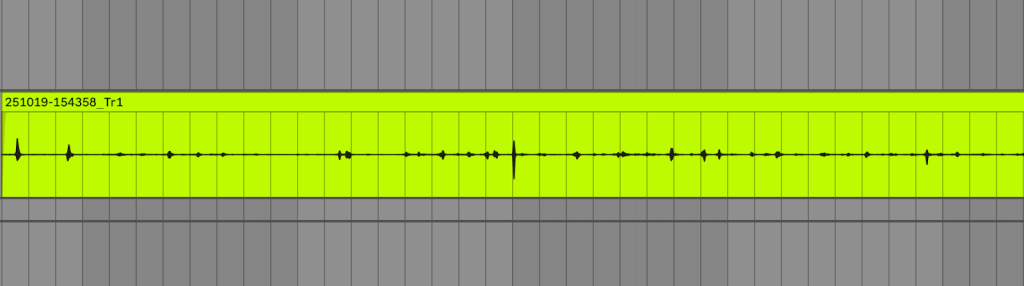
Original recording in Ableton
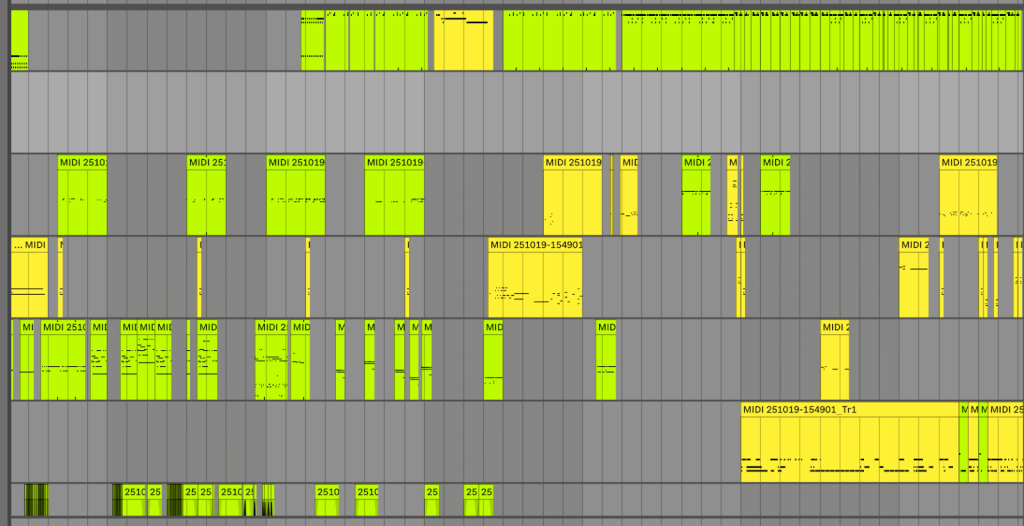
MIDI channels in Ableton
While the hydrophone was busy with its labor of recording, I was also capturing videos on my phone to document this strange liminal place: between land and water, city and industry, natural and manufactured. I used these videos as the basis for the visual components of “Bush Terminal,” the sonic-optic experiment that accompanies this section. In TouchDesigner, I created a chain of visual effects to resemble the sensation of being immersed in this aquatic industrial environment. The visuals are paired with a hybrid soundscape arranged from the hydrophone recording and MIDI notes, which encourages careful attention to the vibrant activity lurking underneath an urban pier. I wanted to create the feeling of being inside the waves, of moving with the water and sand as they shift and merge into something both unified and unique.
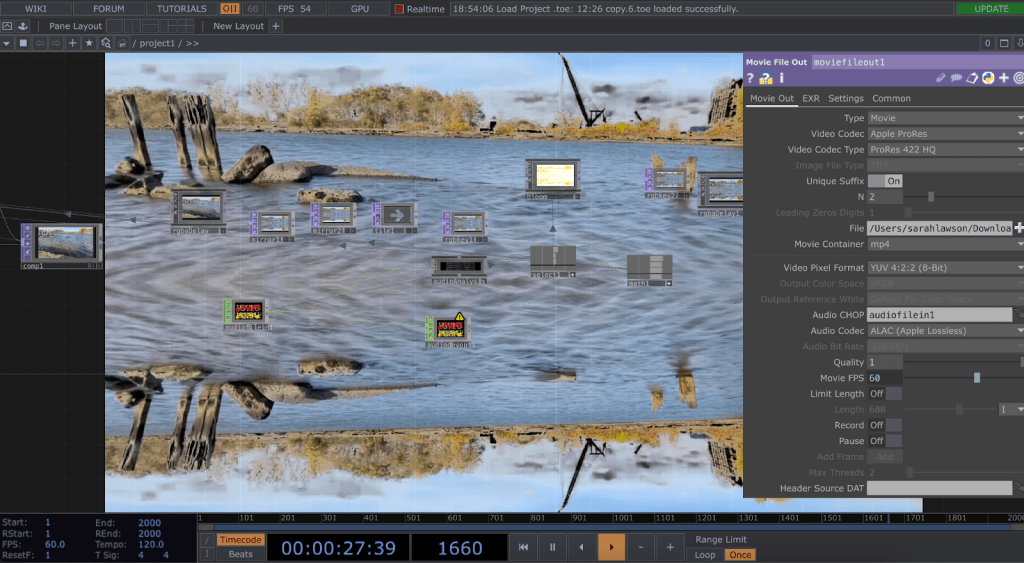
TouchDesigner interface showing chain of visual effects
As I reflect on the creative approach I used to render this complex urban environment, I think of the nature of reference and translation articulated by Bruno Latour in the chapter “Circulating Reference” of his 1999 book Pandora’s Hope. Latour accompanies a team of a botanist, a pedologist, and a geographer into the Brazilian Amazon on a field trip in which the scientists are trying to determine whether a savannah is becoming a forest or vice versa by studying the composition and qualities of soil samples at the border zone. Latour uses the opportunity to examine the nature of reference in the production of knowledge via the scientific method as it takes shape in the field. “With the help of my camera, I will attempt to bring some sort of order to the jungle of scientific practice,” he writes—a sentiment that could apply to my own use of the hydrophone as an underground instrument of detection and observation.
Latour’s work can be translated to my exploration here in a number of ways. As Latour looks critically at the methods used in his field expedition, I am also attempting to ground my experiment epistemologically: by identifying the tools, techniques, and limits of knowledge that frame the endeavor. In other words, “what scientists get to know is never separate from how they get to know it.” The technical instruments in both of our cases work at capturing a portrait of ecological relations, and we operate with the knowledge that it would be impossible to create any kind of definitive or stable representation that doesn’t mutate at some point in the process. This is an apt metaphor for the mutational capacity of microbes.
In the particular aquatic site of Bush Terminal and the urban human-soil-microbial assemblage that I aim to render with my instruments, there is also a curious mutation of boundaries at play: where does the soil descend into sand, or sediment, and thus lose its stability or structure as the object of observation? How do the microbial ecologies shift in tandem with the transformation from soil to sand, and how can I account for this transition zone? In presenting a recorded snapshot, I aim to elucidate the forms of labor involved in translating environmental phenomena into points of observation for scientific understanding.
Like the botanist Edileusa who gathers plant specimens as referential examples in the study at hand—a bouquet that exhibits “two features of reference: on the one hand an economy, an induction, a shortcut, a funnel in which she picks one blade of grass as the sole representative of thousands of blades of grass”—I select a single instance of tide to stand in for the diversity of lifeways that gather in a border zone between one kind of place and another during previous and subsequent tides. And like the report generated from the field expedition, there is a rupture that stands between this prose and the audiovisual representation created by the technical instruments of hydrophone and camera. “Yet there is also a continuity,” Latour writes, because the materials represent the same subject of investigation, “the forest-savanna transition, made ever more certain and precise at each stage,” or the urban human-soil-microbial assemblage that retains its components as an entangled set of lifeways interacting through each act of technological and artistic translation. Latour goes on to say:
It seems that reference is not simply the act of pointing or a way of keeping, on the outside, some material guarantee for the truth of a statement; rather it is our way of keeping something constant through a series of transformations. Knowledge does not reflect a real external world that it resembles via mimesis, but rather a real interior world, the coherence and continuity of which it helps to ensure. What a beautiful move, apparently sacrificing resemblance at each stage only to settle again on the same meaning, which remains intact through sets of rapid transformations. The discovery of this strange and contradictory behavior is worthy of the discovery of a forest able to create its own soil.
This is the intended effect of the translation from physical phenomenon (water moving across the sand, hydrophone capturing the tide while buried deep within it) to digital files, MIDI conversion of sonic activity, and visual chains of effects: to keep the thing at the center, the effort toward urban microontology performed via a series of recordings and conversions, as the constant referent. Instead of striving for a detached reality that repeats across encounters, the basis for attending to relationality with microbial ecologies is a “potentially endless sequence of mediators” that does not need to account for resemblance to establish connection.

 One Moment Just to Drink the Sound